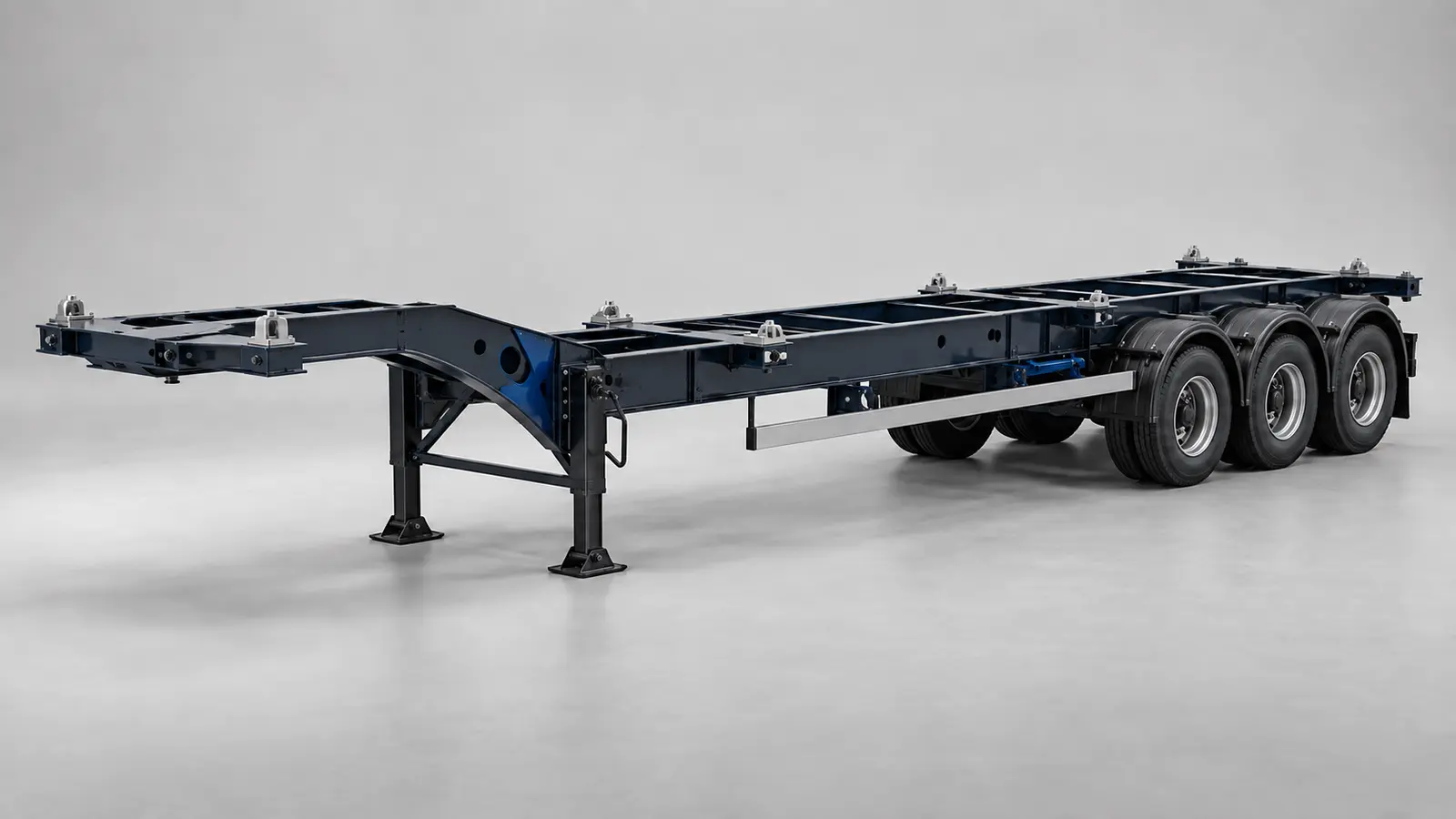
A container chassis is defined by its container interface and supporting frame, not by the contents of a box placed on it. Keep the container, tank or refrigeration equipment as a separate carried entity. Container length alone does not establish that a chassis has the correct locking positions or load distribution.
Configuration decisions and the documentation to request
Decision
What changes
Ask for
Fixed or adjustable chassis
A fixed frame supports a defined arrangement; sliders or telescopic sections alter position or length.
Container standard, twist-lock pattern, lock positions and operating state
Tank or refrigerated container
Carried equipment may need a particular support arrangement, protection or genset. It remains distinct from a tank trailer or reefer body.
Container compatibility, interfaces and power/support requirements
Self-handling or conventional lift
A sidelifter or tipping arrangement changes how the container reaches or leaves the chassis.
Lift/tip envelope, stabilizers, working ground and load chart
Inspect the actual trailer
Inspect twist locks, bolsters and supporting frame for damage or unauthorized repairs.
Operate adjustable sections and confirm positive lock engagement.
Check coupling, suspension and tyre condition in the intended loaded state.
Verify any genset, lifting or tipping equipment against its own manual and identification.
Plan the operating environment
Document container gross weight and the actual support arrangement; do not assume a permitted container weight is the chassis payload. Plan terminal access, axle distribution and chassis operating position for the route and handling equipment.
For route-specific checks, start with the applicable provincial authority. Alberta permit resources ↗ and Ontario permit resources ↗ explain their respective processes; neither is a Canada-wide clearance rule.
Chassis carries a separately framed ISO tank entity.
Sidelifter
Onboard lifting arms transfer the container beside the chassis.
PHYSICAL BOUNDARY
How to identify this trailer family
A chassis or self-handling carrier built around a documented container interface, length and locking pattern is canonical here; the carried container remains a separate entity.
KEEP SEPARATE
Related equipment with a different purpose
Tank container versus highway tank trailer
Reefer container versus refrigerated highway trailer
Intermodal gooseneck chassis versus pickup-tow commercial gooseneck
Traveling-axle equipment platform used to load a container versus skeletal container chassis
INSTALLED SYSTEMS
Components do not replace the trailer identity
Twist-lock / pin and lock interface
Reefer genset package
Hydraulic tipping system
Sidelifter / self-loading crane system
COMBINATION OVERLAYS
Position does not duplicate the body model
Reverse B-Train
B-Train
BEFORE YOU SELECT
Unknown values stay unknown.
Family membership does not establish a model's dimensions, rating, legal payload, compatibility or current availability.