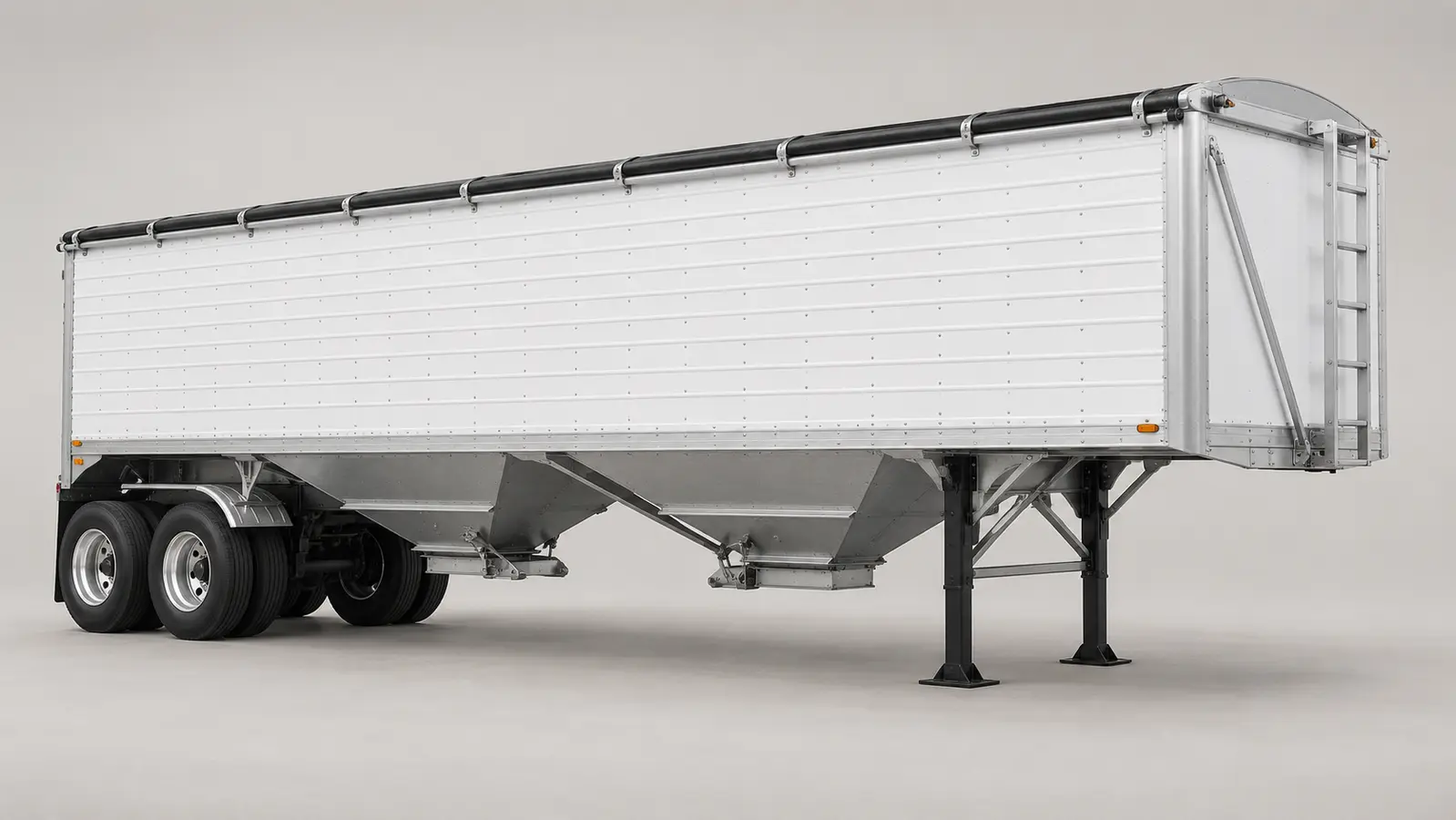
Grain and agricultural commodity trailers are selected by the product, unloading interface and combination. A gravity hopper releases cargo through traps; an agricultural tender may add conveying equipment. A Super-B describes a combination arrangement rather than replacing the body identity.
Configuration decisions and the documentation to request
Decision
What changes
Ask for
Commodity and cleanout
Grain, seed and fertilizer can require different liners, seals and contamination controls.
Previous cargo, cleanout access and material compatibility
Traps and receiver
Hopper openings must work with the receiving pit or conveyor. Clearance under the traps can control access.
Trap locations, discharge clearance and operating access
Single or coupled configuration
Axles and body position affect the complete assembly.
Lead/rear arrangement, coupling, tare and axle spacing
Inspect the actual trailer
Operate every trap and inspect seals, rollers and frames.
Inspect hopper slopes and seams for damage and corrosion.
Check tarp and moisture protection at the loading opening.
Confirm combination components and the actual equipped weight.
Plan the operating environment
Plan unloading around the receiver and product flow. Winter freezing, fertilizer corrosion and carryover between commodities require operation-specific attention. Do not use a hopper-bottom label as proof of a bottom-dump construction or permit class.
For route-specific checks, start with the applicable provincial authority. Alberta permit resources ↗ and Ontario permit resources ↗ explain their respective processes; neither is a Canada-wide clearance rule.
hopper bottom as belly dump · gravity wagon as highway semi-trailer
MANUFACTURER REFERENCES
3 documented models
3 specification references cover 1 trailer architecture. Open the specification library for model-specific documentation.
MODEL COVERAGE
Documented trailer configurations
Model references are supported by manufacturer documentation. Check each configuration for its available dimensions and ratings.
ARCHITECTURE REFERENCE
1 reviewed mechanism view
Each reference shows the feature that controls classification. It is not a dimension, rating, compatibility or availability source.
TRAILER MECHANISMS
Gravity body versus powered tender
The commodity body and verified discharge path distinguish a highway hopper from an agricultural tender; combination position remains a separate overlay.
Gravity hopper
Hopper cones and bottom traps create the gravity-discharge path.
Agricultural tender
A documented conveyor or auger transfers seed or fertilizer from the body.
PHYSICAL BOUNDARY
How to identify this trailer family
A gravity hopper body or an integrated agricultural tender system is canonical here; commodity labels and combination position remain separate facets.
KEEP SEPARATE
Related equipment with a different purpose
Gravity hopper versus bottom / belly dump
Agricultural tender versus ordinary hopper
Belt / conveyor self-unloading body
Moving-floor / reciprocating-slat body
INSTALLED SYSTEMS
Components do not replace the trailer identity
Trap and chute system
Integrated conveyor or auger
Commodity-specific liner or cleanout package
COMBINATION OVERLAYS
Position does not duplicate the body model
Super-B
B-Train
Lead and pup
BEFORE YOU SELECT
Unknown values stay unknown.
Family membership does not establish a model's dimensions, rating, legal payload, compatibility or current availability.