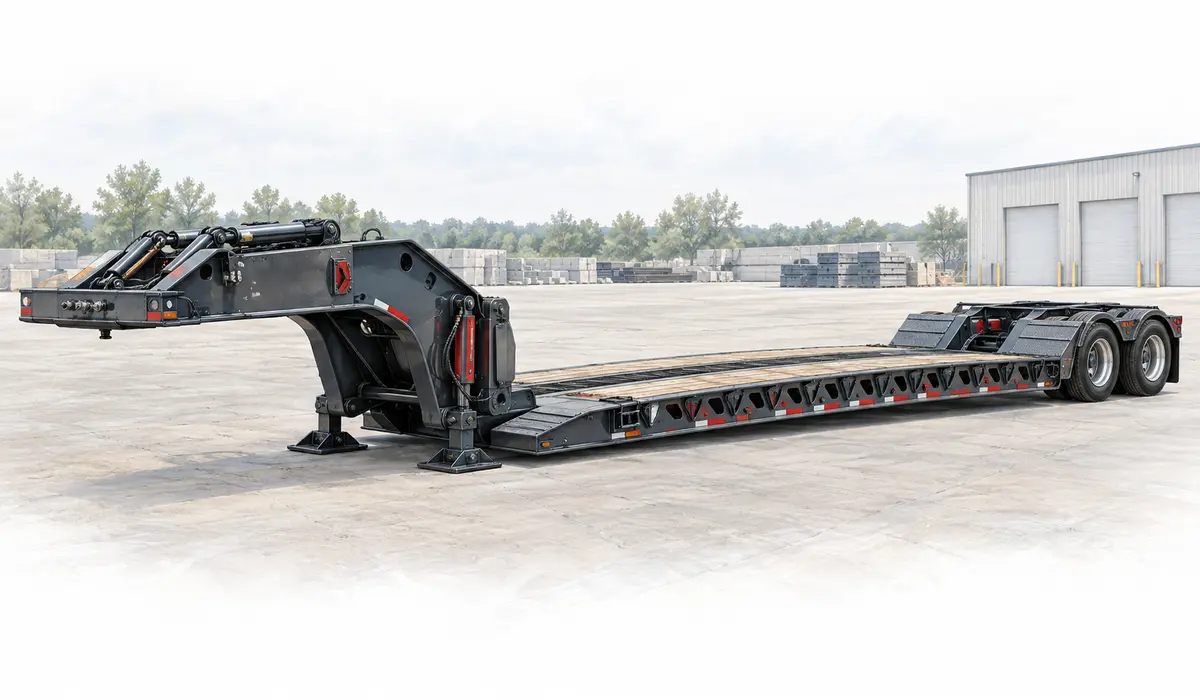
A current hydraulic detachable gooseneck lowbed with a documented 24 ft main deck and a 70,000 lb concentrated rating over 12 ft.
The usable well, loaded height and neck clearance govern the starting configuration.
Loading path
Front detach
Front access depends on detaching and reconnecting the hydraulic neck. Review the approach, supporting ground and the machine’s lowest components with the actual operating procedure.
Supporting the load
Track or tyre contacts must sit on suitable structure inside the well. A nominal well length does not establish unobstructed support space.
Dimensions that govern this configuration
Usable support space, nominal deck spans and the overall transport envelope remain separate measurements.
B
Main deck / well length (nominal)24 ft7,315 mm
Documented spans Shared numeric scale
Spans compare documented values. They are not positioned or scaled to the photograph.
Tare, gross vehicle rating and structural load ratings describe different limits. None alone establishes allowable payload or legal axle loads.
Plan around the actual load
These applications identify what to investigate. Suitability depends on the transported assembly, support points and the selected trailer build.
Excavators
Will the stowed machine fit the well?
Track footprint length alone is insufficient. Record where the rollers react into the tracks, and check side rails, outriggers and the position of the machine centre of gravity.
Can the tyres and articulation fit the loading path?
Concentrated wheel loads need deck and crossmember verification. Record the actual tyre contact lines rather than treating the whole machine length as load distribution.
Current TKHDG model; cross-reference TK110HDG for family context.Source ↗
Configuration & inspection
Production start is not established by the current product page.
Confirm neck settings, deck height and auxiliary axle compatibility from the build sheet.
Equipment selection requires verified weights and ratings, load support, coupling and axle analysis, securement planning and route review. This reference is not engineering, permit or route-clearance approval.