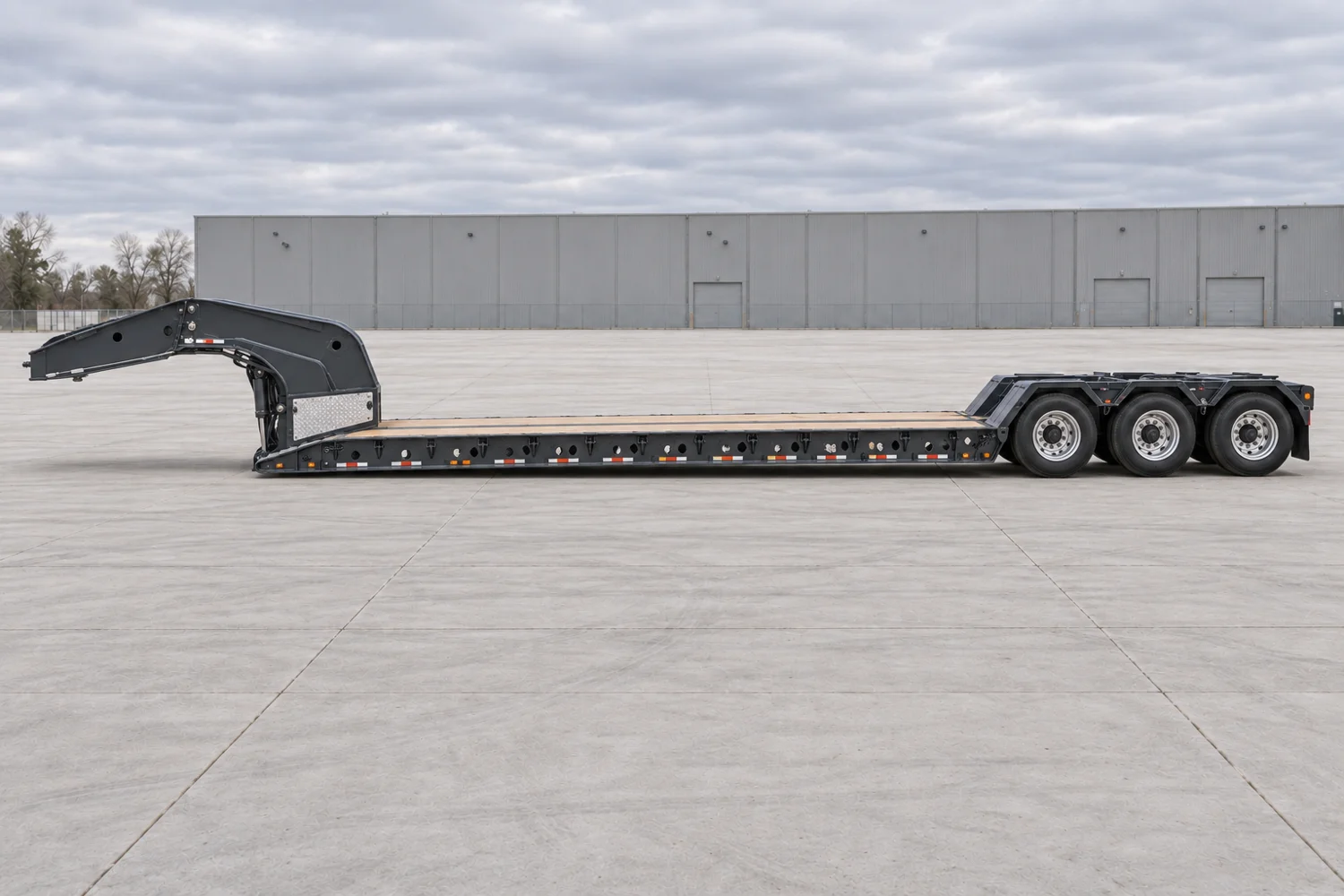
A four-beam hydraulic detachable lowbed with a documented 26 ft main deck. The product sheet separates the main deck, complete length and coupler geometry.
The usable well, loaded height and neck clearance govern the starting configuration.
Loading path
Front detach
Front access depends on detaching and reconnecting the hydraulic neck. Review the approach, supporting ground and the machine’s lowest components with the actual operating procedure.
Supporting the load
Track or tyre contacts must sit on suitable structure inside the well. A nominal well length does not establish unobstructed support space.
Other configurations of this model
Compare the changes in height, coupling or extension state before switching references.
26 ft7,925 mm · Manufacturer stated; loading condition not specifiedSource ↗
Overall transport length
53 ft16,154 mm · Manufacturer stated; loading condition not specifiedSource ↗
Overall / side-rail width
8 ft 6 in2,591 mm · Manufacturer stated; loading condition not specifiedSource ↗
Coupling & running gear
Coupler height
4 ft1,219 mm · Documented option; verify as-built geometrySource ↗
Kingpin setback
1 ft 4 in406 mm · Manufacturer stated; loading condition not specifiedSource ↗
Swing clearance
7 ft2,134 mm · Manufacturer stated; loading condition not specifiedSource ↗
Still needed from the build sheet
Usable main deck / well length
Main-deck height
Ground clearance
Usable support width
Ratings & support conditions
The exact build’s load chart is required. A model-family capacity range does not establish this configuration’s rating.
Tare, gross vehicle rating and structural load ratings describe different limits. None alone establishes allowable payload or legal axle loads.
Plan around the actual load
These applications identify what to investigate. Suitability depends on the transported assembly, support points and the selected trailer build.
Excavators
Will the stowed machine fit the well?
Track footprint length alone is insufficient. Record where the rollers react into the tracks, and check side rails, outriggers and the position of the machine centre of gravity.
Counterweight stacks create concentrated reactions; lattice boom sections may require separated supports. A distributed deck rating cannot stand in for either case.
Side-rail width does not establish unobstructed support width. Ratings need the exact build documentation.
Documented optional configuration. Numeric ratings are withheld until the matching build-specific chart is confirmed.
The product name is a capacity class; obtain the load concentration chart before assigning a payload limit.
Published deck height has no loading-state qualifier, so it does not automatically feed a loaded-height calculation.
Equipment selection requires verified weights and ratings, load support, coupling and axle analysis, securement planning and route review. This reference is not engineering, permit or route-clearance approval.