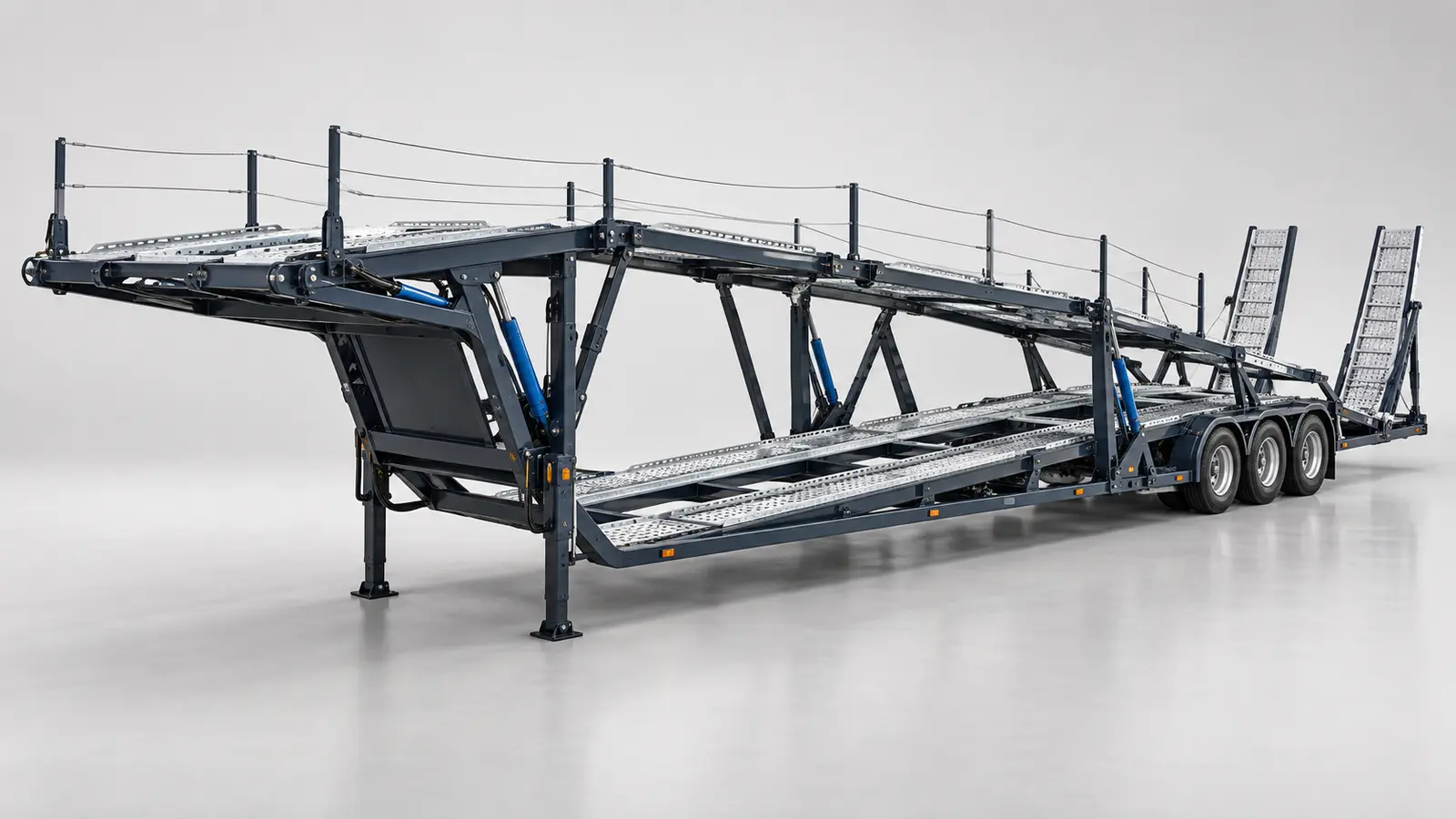
Vehicle transporters are selected around the vehicles, their loading paths and the complete truck-and-trailer envelope. Advertised vehicle count does not establish usable positions for a different mix of cars, pickups or vans. High-mount and stinger-steered layouts also need the correct power-unit interface.
Configuration decisions and the documentation to request
Decision
What changes
Ask for
Vehicle mix
Wheelbase, ground clearance, roof height and mass determine how each position can be used.
Per-position envelope and load distribution
Open or enclosed
Enclosure changes clearance, access and working space. Stacker arrangements add moving decks and loading sequences.
Door aperture, deck movement and service access
Coupling and loading path
Carrier articulation and headrack arrangements are part of the complete system.
Tractor/headrack compatibility, approach and turning envelope
Inspect the actual trailer
Operate moving decks and inspect locks, cylinders and hoses.
Check wheel restraint anchors, tracks and working access.
Inspect ramps and transitions for the lowest-clearance vehicle.
Confirm the complete assembled height after loading.
Plan the operating environment
Plan the loading sequence before treating a position count as a usable vehicle mix. Keep combination height and axle distribution separate from individual deck capacity. Vehicle securement must suit the actual equipment and responsible carrier’s procedure.
For route-specific checks, start with the applicable provincial authority. Alberta permit resources ↗ and Ontario permit resources ↗ explain their respective processes; neither is a Canada-wide clearance rule.
How many and what classes of vehicles must be carried?
Which loading path and deck movement fit the vehicles?
What headrack, securement and height constraints apply?
SPECIFICATION CHECKLIST
Useful fields for this family
vehicle positions
carrier layout
enclosure
headrack
securement
truck/SUV package
COMMON TERMINOLOGY
Other names you may encounter
car hauler · auto transporter · stinger car carrier
COMPARE CAREFULLY
Similar terms, different equipment
stinger as any trailer coupling · enclosed freight van
MANUFACTURER REFERENCES
1 documented model
1 specification reference covers 1 trailer architecture. Open the specification library for model-specific documentation.
MODEL COVERAGE
Documented trailer configurations
Model references are supported by manufacturer documentation. Check each configuration for its available dimensions and ratings.
ARCHITECTURE REFERENCE
1 reviewed mechanism view
Each reference shows the feature that controls classification. It is not a dimension, rating, compatibility or availability source.
TRAILER MECHANISMS
Carrier layout and coupling remain distinct
Vehicle positions, loading paths, deck movement, headrack and coupling arrangement define the transporter architecture.
Multi-car trailer
Trailer-only multi-position open carrier layout.
High-mount / stinger
Headrack and low rear coupling create a combined tractor-trailer carrier.
Enclosed transporter
Purpose-built enclosed vehicle loading and securement path.
PHYSICAL BOUNDARY
How to identify this trailer family
The carrier architecture is established by its vehicle positions, loading path and deck or headrack arrangement; advertised vehicle count alone is not an architecture.
KEEP SEPARATE
Related equipment with a different purpose
Hydraulic double-deck versus wedge multi-car
High-mount versus stinger-steered
Enclosed professional transporter versus enclosed stacker
General enclosed freight van
INSTALLED SYSTEMS
Components do not replace the trailer identity
Hydraulic deck movement
Headrack / over-cab structure
Winch and vehicle securement package
BEFORE YOU SELECT
Unknown values stay unknown.
Family membership does not establish a model's dimensions, rating, legal payload, compatibility or current availability.