Step deck / single drop · Talbert

60FG

Manufacturer standard reference

Full model specifications →

Step deck / single drop

How this platform works

A fixed-gooseneck oil-field trailer with standard and alternate swing-clearance references. Distributed and concentrated capacities retain separate support conditions, and the neck setting must match the tractor configuration.

Treat the upper deck and lower main deck as separate working areas.

Loading path

Winch / crane; verify loading procedure

Side or crane loading needs access to both deck levels. Drive-on loading requires the specified ramps and a checked transition path.

Supporting the load

An overall trailer length includes the upper deck and other structure. Do not subtract one published span to invent a usable lower-deck length.
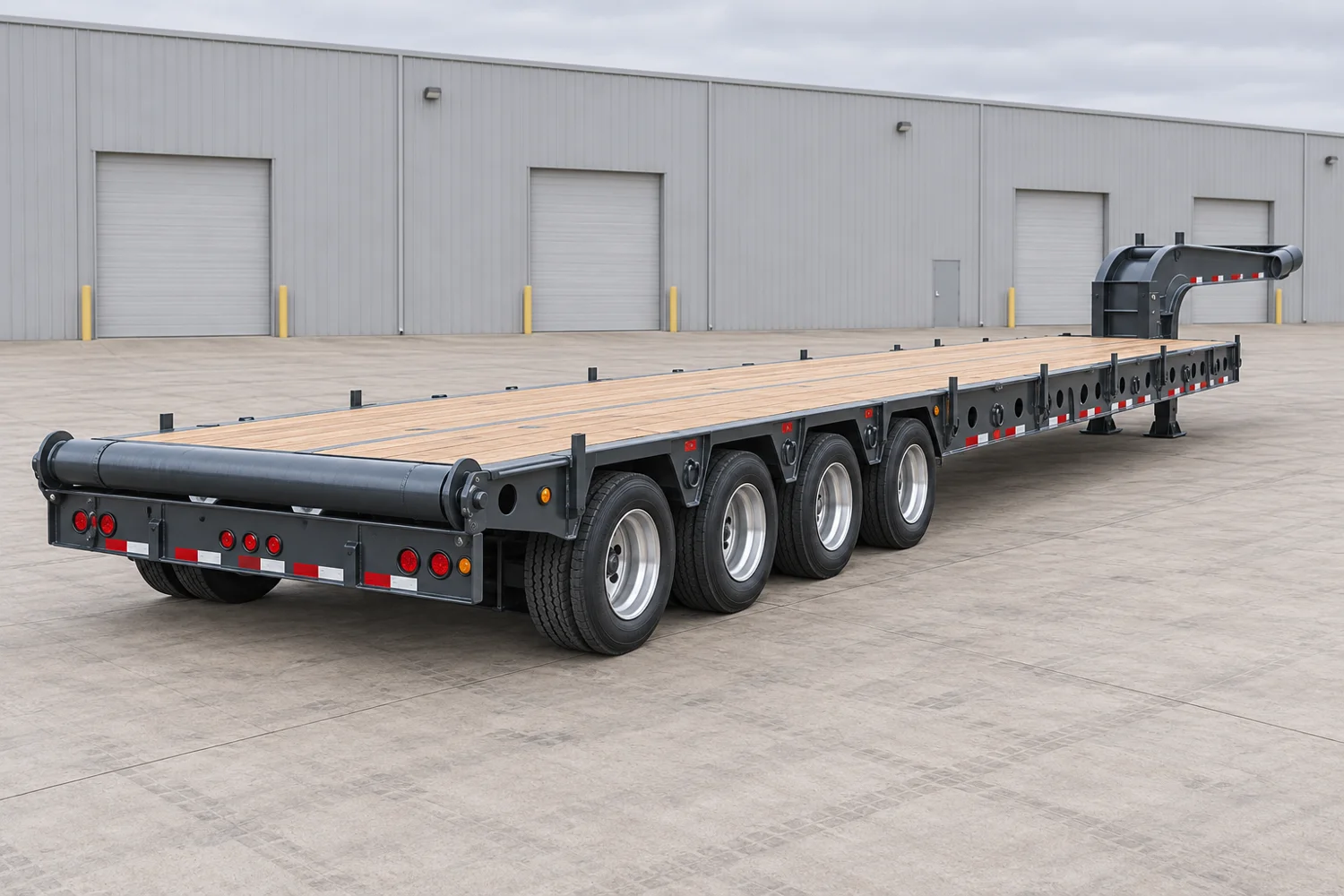
Other configurations of this model

Compare the changes in height, coupling or extension state before switching references.

Dimensions that govern this configuration

Usable support space, nominal deck spans and the overall transport envelope remain separate measurements.

C
Overall / side-rail width8 ft 6 in2,591 mm

Documented spans Shared numeric scale

C Overall / side-rail width: 8 ft 6 inC8 ft 6 in

Spans compare documented values. They are not positioned or scaled to the photograph.

Manufacturer stated; configuration reference

View dimension source ↗

Documented dimensions

Deck & transport envelope

Overall / side-rail width
8 ft 6 in2,591 mm · Manufacturer stated; configuration referenceSource ↗

Coupling & running gear

Swing clearance
9 ft2,743 mm · Manufacturer stated; configuration referenceSource ↗

Still needed from the build sheet

  • Main deck / well length (nominal)
  • Usable main deck / well length
  • Upper-deck length
  • Main-deck height
  • Overall transport length
  • Usable support width

Ratings & support conditions

distributed120,000 lb54,431 kg

Even distribution; verify configuration chart

Rating source ↗
concentrated · 16 ft support length110,000 lb49,895 kg

Stated support length

Rating source ↗

Tare, gross vehicle rating and structural load ratings describe different limits. None alone establishes allowable payload or legal axle loads.

Plan around the actual load

These applications identify what to investigate. Suitability depends on the transported assembly, support points and the selected trailer build.

Generators & industrial skids

Does the skid footprint match the structural support?

Locate the skid rails over suitable structure. Check whether levelling blocks, isolators or delicate equipment prohibit support at other points.

  • Skid contact rails and support spacing
  • Total packaged height with dunnage
  • Lifting-point access and enclosure width
Crane components

Where must the component be supported?

Counterweight stacks create concentrated reactions; lattice boom sections may require separated supports. A distributed deck rating cannot stand in for either case.

  • Component length and maximum section width
  • Approved support and lifting points
  • Component weight and centre of gravity

Documented build details

Construction
Steel
Neck
fixed
Running gear
Exact axle arrangement requires build confirmation
Manufacturer detail
Fixed Gooseneck Narrow Type with High Arch ProfileSource ↗
Manufacturer detail
108-in. Swing Radius with Alternate Setting at 96-in.Source ↗
Manufacturer detail
Air Lift on Axle 4Source ↗
Manufacturer detail
35-42 in. Loaded Deck HeightSource ↗
Manufacturer detail
Cable Roller with Spherical Bearings Between Gooseneck Mainbeams at Rear, Pin Pockets in Front of RollerSource ↗
Manufacturer detail
Removable Plate Between Gooseneck Mainbeams to Walk onSource ↗
Manufacturer detail
Two Pair of Pipe Pockets Inside Side Beam FlangeSource ↗
Manufacturer detail
2 in. Apitong FlooringSource ↗
Manufacturer detail
Axle Stops on Last Axle to Prevent Crushing when LoadingSource ↗
Manufacturer detail
Construction: T1 BeamsSource ↗
Manufacturer detail
Lightening Holes in Deck Side BeamsSource ↗

Configuration & inspection

  • Obtain the actual build sheet and configuration-specific load chart.
  • Published options and family ranges do not establish an individual trailer’s equipment.

Equipment selection requires verified weights and ratings, load support, coupling and axle analysis, securement planning and route review. This reference is not engineering, permit or route-clearance approval.