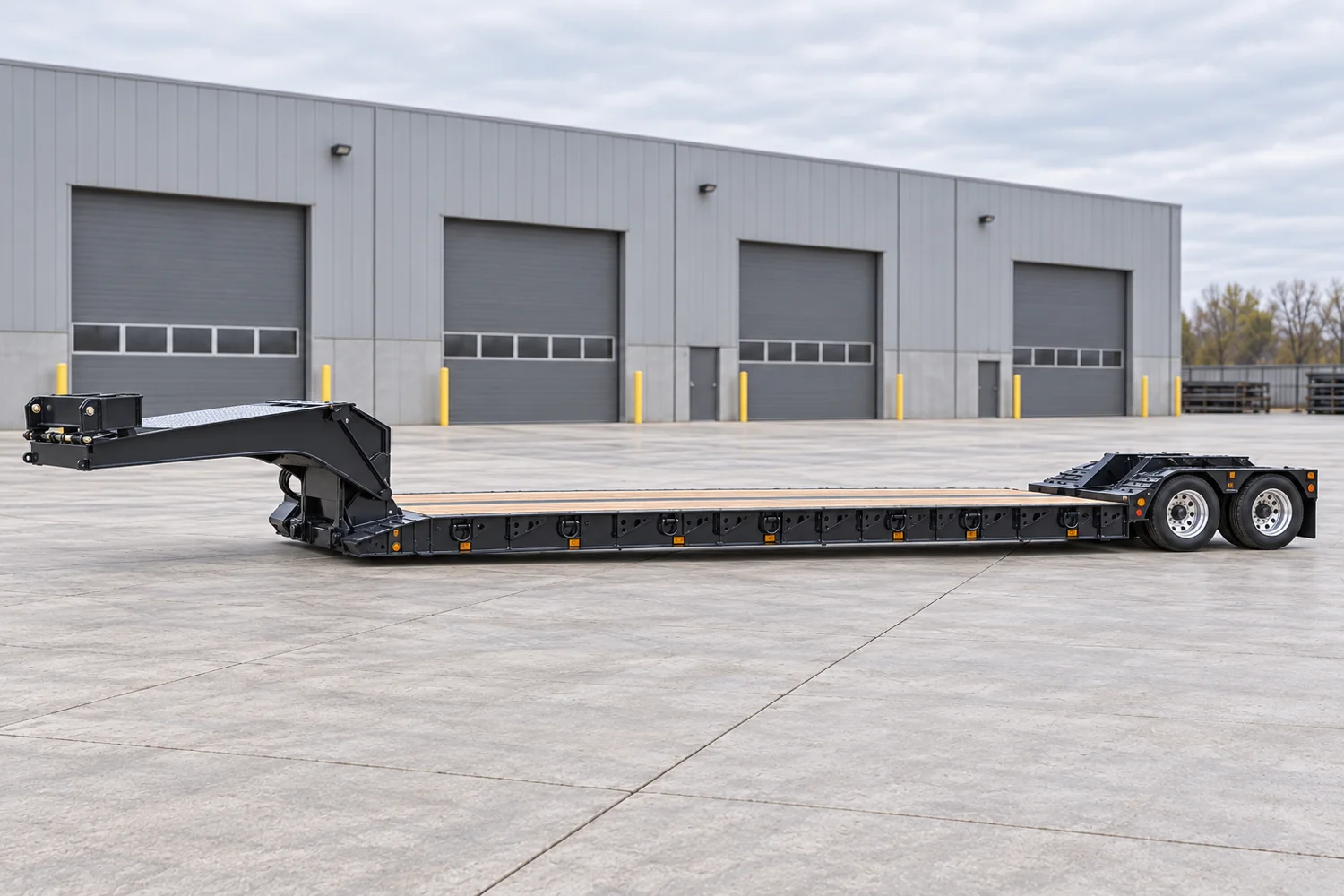
A mechanical-detachable extendable double drop with a documented 48 ft overall reference and tandem axle arrangement. Extension position and support capacity require their own evidence; the family name does not define a single rating.
The selected open or closed state belongs with its own dimensions and rating chart.
Loading path
Front detach
Establish the required extension, locking position and loading sequence using the manufacturer’s procedure. Check the trailer in its transport state after loading.
Supporting the load
An open telescoping span is not necessarily continuous flooring. Confirm the cargo’s permitted support positions and the extension-specific chart.
Dimensions that govern this configuration
Usable support space, nominal deck spans and the overall transport envelope remain separate measurements.
A
Overall transport length48 ft14,630 mm
Documented spans Shared numeric scale
Spans compare documented values. They are not positioned or scaled to the photograph.
6 ft 8 in2,032 mm · Manufacturer stated; configuration referenceSource ↗
Still needed from the build sheet
Usable main deck / well length
Main deck / well length (nominal)
Upper-deck length
Deck transition drop
Usable support width
Ratings & support conditions
The exact build’s load chart is required. A model-family capacity range does not establish this configuration’s rating.
Tare, gross vehicle rating and structural load ratings describe different limits. None alone establishes allowable payload or legal axle loads.
Plan around the actual load
These applications identify what to investigate. Suitability depends on the transported assembly, support points and the selected trailer build.
Excavators
Will the stowed machine fit the well?
Track footprint length alone is insufficient. Record where the rollers react into the tracks, and check side rails, outriggers and the position of the machine centre of gravity.
30–55 ton is a family range, not one exact trailer rating. Confirm the capacity model and load chart; do not interpolate.
Obtain the actual build sheet and configuration-specific load chart.
Published options and family ranges do not establish an individual trailer’s equipment.
Equipment selection requires verified weights and ratings, load support, coupling and axle analysis, securement planning and route review. This reference is not engineering, permit or route-clearance approval.