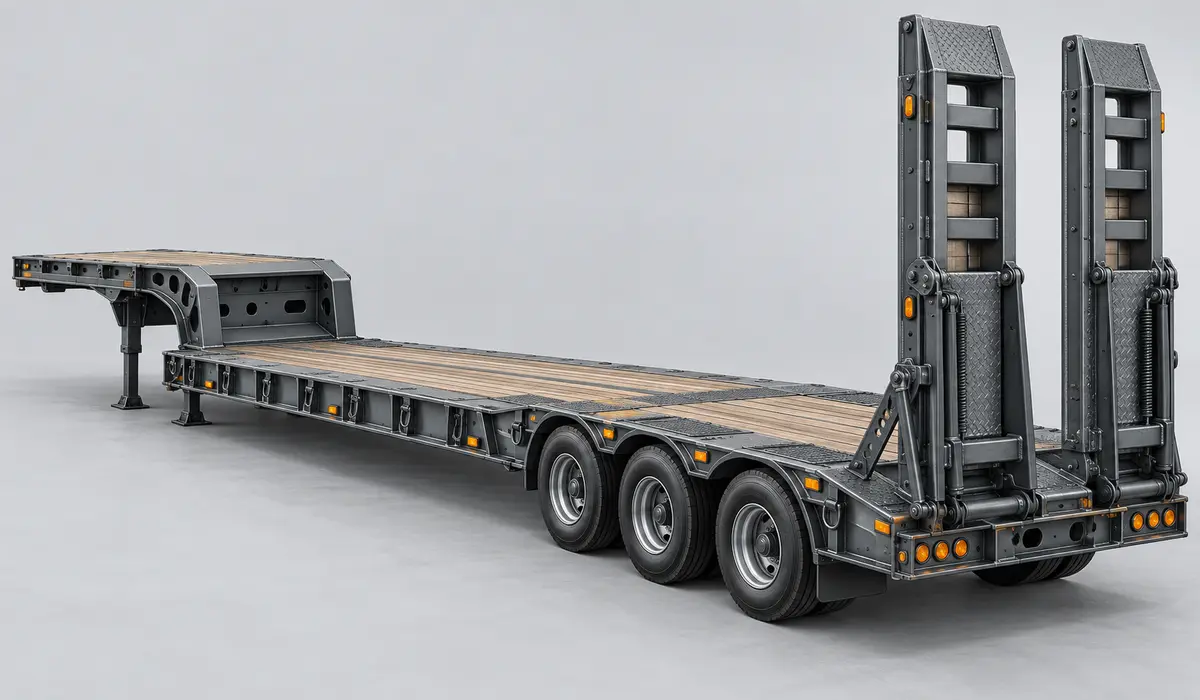
The current Doepker steel drop-deck with ramps, retained as a distinct loading-mechanism product rather than a cosmetic option.
Treat the upper deck and lower main deck as separate working areas.
Loading path
Integrated rear ramp loading
Side or crane loading needs access to both deck levels. Drive-on loading requires the specified ramps and a checked transition path.
Supporting the load
An overall trailer length includes the upper deck and other structure. Do not subtract one published span to invent a usable lower-deck length.
Dimensions that govern this configuration
Usable support space, nominal deck spans and the overall transport envelope remain separate measurements.
B
Main deck / well length (nominal)Not documentedConfiguration-specific measurement required
The reference does not establish this measurement.
Documented dimensions
Still needed from the build sheet
Main deck / well length (nominal)
Usable main deck / well length
Upper-deck length
Main-deck height
Overall transport length
Overall / side-rail width
Usable support width
Ratings & support conditions
The exact build’s load chart is required. A model-family capacity range does not establish this configuration’s rating.
Tare, gross vehicle rating and structural load ratings describe different limits. None alone establishes allowable payload or legal axle loads.
Plan around the actual load
These applications identify what to investigate. Suitability depends on the transported assembly, support points and the selected trailer build.
Wheel loaders
Can the tyres and articulation fit the loading path?
Concentrated wheel loads need deck and crossmember verification. Record the actual tyre contact lines rather than treating the whole machine length as load distribution.
Axle and suspension choices are configuration-specific
Configuration & inspection
Obtain the exact Doepker build sheet and configuration-specific load chart before matching a load.
Do not infer production years, payload or legal axle loading from a catalog date or model-class name.
Equipment selection requires verified weights and ratings, load support, coupling and axle analysis, securement planning and route review. This reference is not engineering, permit or route-clearance approval.