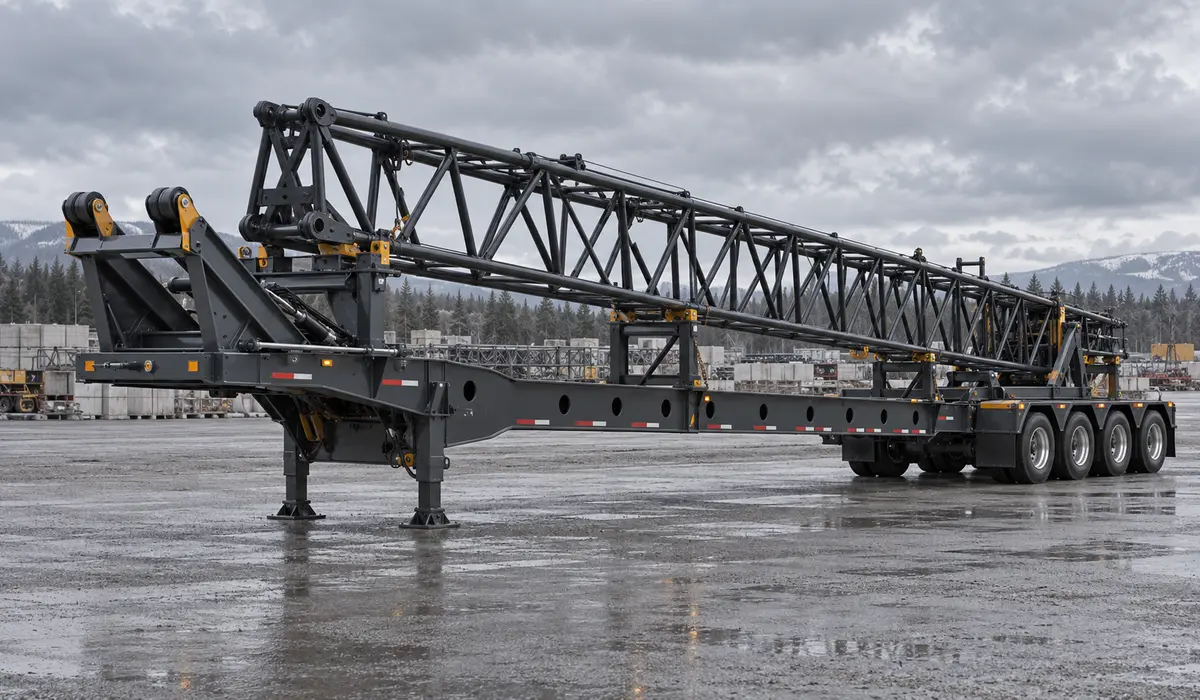
Temisko crane-hauling product that transports a removed crane boom and launches it back into the crane at the jobsite.
Beam locations and the load’s support geometry control the usable space.
Loading path
Crane boom transport · On-site boom launching into the crane
Confirm the specified neck arrangement and loading or lifting procedure. The open areas around beams are not continuous deck support.
Supporting the load
Locate the approved load contacts on the intended beams and check the configuration-specific load chart. Overall width does not identify usable bearing width.
Dimensions that govern this configuration
Usable support space, nominal deck spans and the overall transport envelope remain separate measurements.
B
Main deck / well length (nominal)Not documentedConfiguration-specific measurement required
The reference does not establish this measurement.
Documented dimensions
Still needed from the build sheet
Main deck / well length (nominal)
Usable main deck / well length
Usable support width
Main-deck height
Ground clearance
Axle spacing
Ratings & support conditions
The exact build’s load chart is required. A model-family capacity range does not establish this configuration’s rating.
Tare, gross vehicle rating and structural load ratings describe different limits. None alone establishes allowable payload or legal axle loads.
Plan around the actual load
These applications identify what to investigate. Suitability depends on the transported assembly, support points and the selected trailer build.
Crane components
Where must the component be supported?
Counterweight stacks create concentrated reactions; lattice boom sections may require separated supports. A distributed deck rating cannot stand in for either case.
Launcher frame and running gear; exact axle layout is build-specific
Configuration & inspection
The manufacturer describes the operating concept; dimensions, ratings and production dates remain build-specific or unresolved.
Obtain the project-specific Temisko engineering package, build sheet and load chart.
Named tonnage classes, component layouts and extension states remain configuration evidence unless the source expressly qualifies a value.
Equipment selection requires verified weights and ratings, load support, coupling and axle analysis, securement planning and route review. This reference is not engineering, permit or route-clearance approval.